Maintenance websites built for contracts and emergency calls.
Websites for US property maintenance firms — response times published, planned maintenance set out in detail, inspection schedules, and licensed multi-trade crews that landlords and property managers can hire from the page.
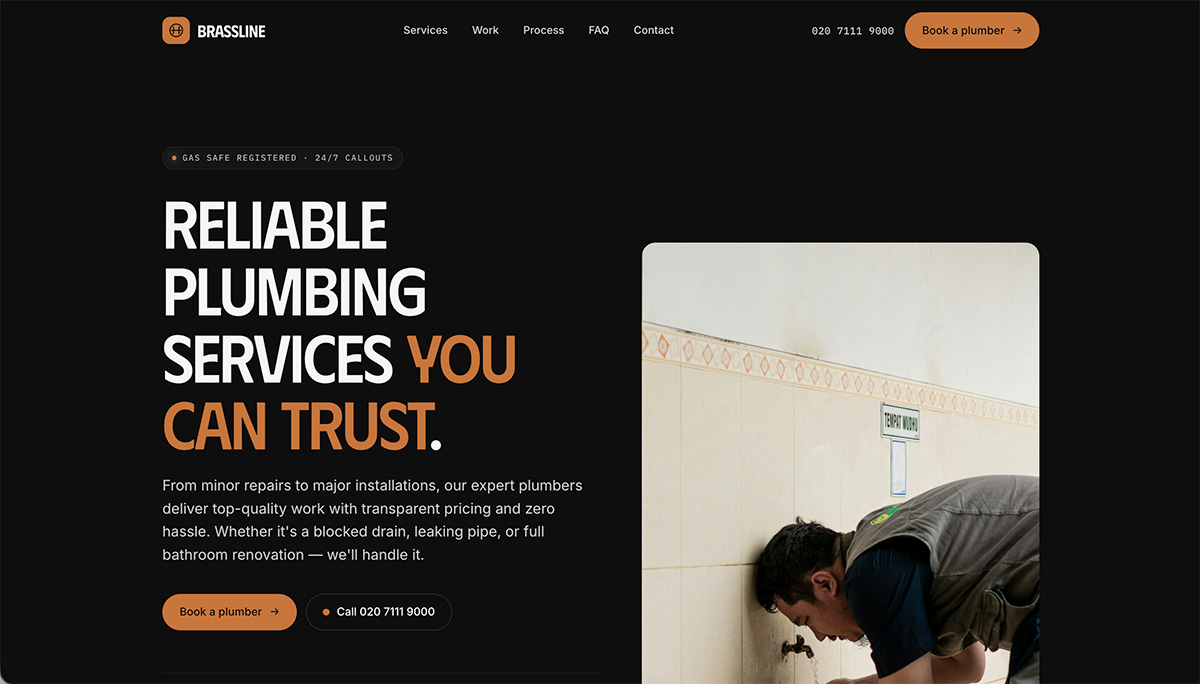
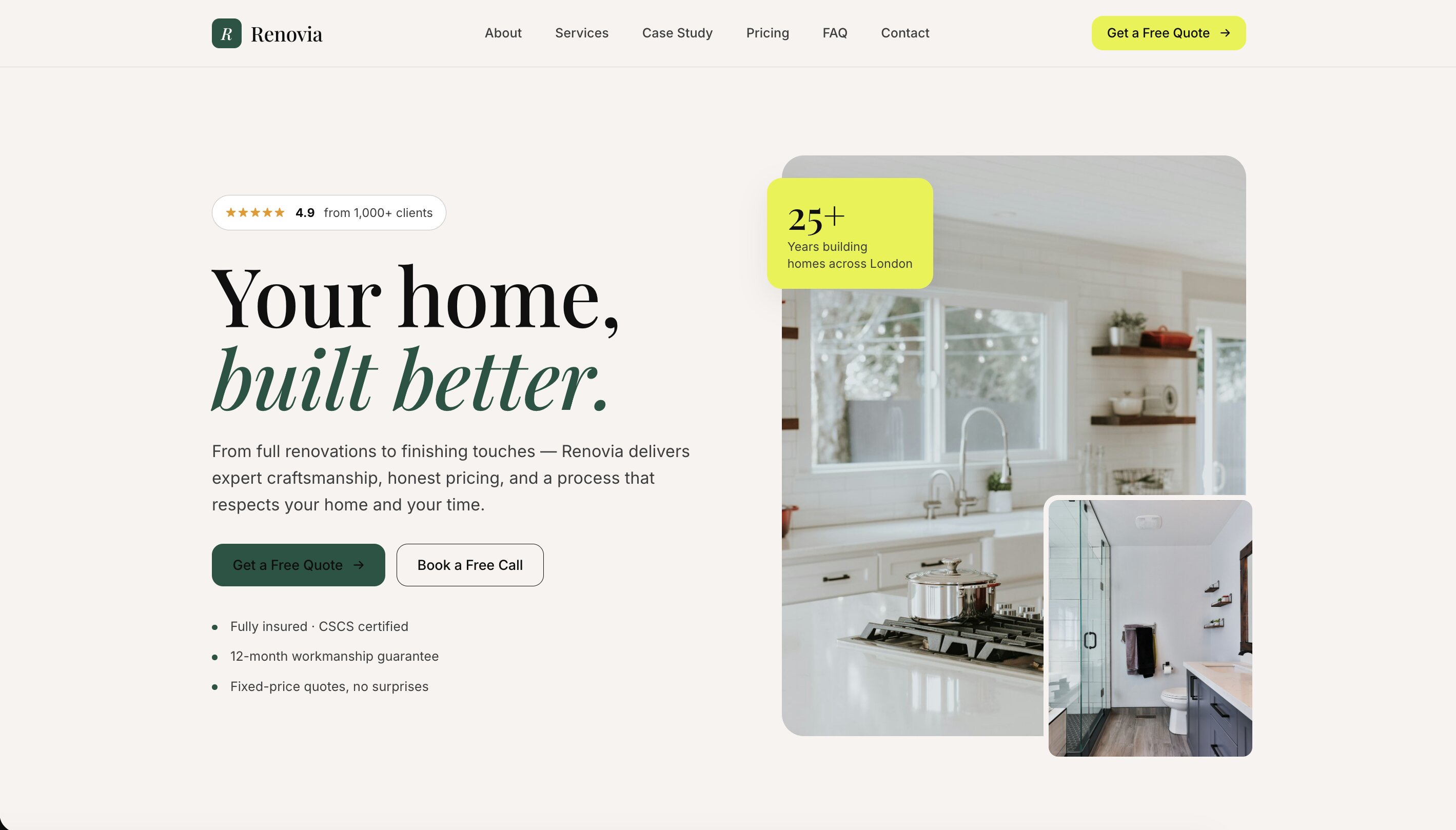
The closest builds in our library — general building, renovation and mechanical. Open any of them to see how a trade list, response section and contract pages sit together.
Maintenance gets bought by people already dealing with a problem — a leak in an apartment, a failed inspection, a portfolio with no reliable contractor. They shortlist on how fast you answer, what you can cover, and whether your paperwork will stand up.
Publish your response times.
Emergency within four hours, urgent within twenty-four, routine within five business days — whatever your real numbers are, printing them beats every competitor writing fast, friendly service. It is also the first thing a property manager compares.
Sell the contract, not the emergency call.
Emergency work is unpredictable and price-shopped. Planned maintenance is recurring revenue. Set out the schedules, what each visit includes, the priority contract customers get, and how it works across a whole portfolio.
Show the whole trade list in one place.
Landlords and property managers want one number for plumbing, electrical, roofing, carpentry, painting, drains and grounds. Listing every trade you cover in-house — and being straight about what you subcontract — is what wins the portfolio.
Prove the compliance side.
Backflow testing, electrical and fire-alarm inspections, water heater and boiler inspections, fire door and emergency lighting checks, elevator and life-safety coordination — with certificates issued on time and stored properly. Property managers carry the legal exposure here, so the firm that documents it well is the safer hire.
What's in the site
Built around how maintenance firms win contracts.
Every feature either answers an emergency call faster, sets out a contract clearly, or proves the compliance work will be documented properly.
01
Response times and coverage, above the fold.
Emergency, urgent and routine windows, the ZIP codes covered, after-hours arrangements and the number that reaches an actual person at 11pm. Sticky on mobile, so reporting a problem is one tap.
02
Planned maintenance contract pages.
Schedules by property type, what each visit covers, frequency, certification issued, priority response for contract customers and how the work is reported back. Enough for a property manager to shortlist you without a meeting.
03
A page per client type.
Private landlords, property management companies, HOAs and condo associations, commercial and retail units, affordable housing operators, short-term rentals and offices — each written with that buyer's concerns and search terms rather than one shared paragraph.
04
Compliance and certification page.
Backflow testing, electrical and fire-alarm inspections, water heater inspections, fire door and emergency lighting checks, and EPA Lead-Safe and asbestos awareness — what you carry out, the licenses behind it, and how certificates get issued and stored.
05
Trade list with in-house and subcontract marked.
Every trade you cover, honestly labeled. Property managers place more work with a firm that says what it subcontracts than with one that claims everything and then misses a deadline on a Friday afternoon.
06
Job reporting and photo evidence.
How work comes back to the client — before and after photos, sign-off sheets, invoices against a property reference. It is the part of the service property managers talk about most, and it rarely makes it onto a maintenance website.
FAQ
Property Maintenance website FAQs.
The questions property maintenances ask before they hit the “get a price” button.
How much does a property maintenance website cost in the US?
A property maintenance website from ConstructionWebExperts is $2,000, fixed price, or $3,000 with branding. Freelancers charge $75–$150/hour and agencies want $10,000–$40,000 per project over 8–12 weeks. Hosting and SSL are included for the first year, and there are no monthly fees.
How long does it take to build a property maintenance website?
Seven days from kickoff to live. ConstructionWebExperts starts from a proven maintenance layout, loads your trades, response times, contract tiers and compliance detail, and ships it.
What should a property maintenance website include?
Published response times, the ZIP codes covered, an after-hours number, planned maintenance detail, a page per client type (landlords, property managers, HOAs, commercial), compliance and certification, and how jobs are reported back with photo evidence.
How do we win work from property management companies?
Write for their risk rather than your service list. Property managers care about response times, whether certificates arrive before the deadline, whether tenants get treated properly, and whether one number covers every trade. A page addressing each of those does more than a gallery.
Should we show emergency service call prices?
Show the structure rather than a single figure: trip charge, hourly or half-day rate, after-hours premium, and what changes for contract customers. It filters price-shoppers and makes the contract look like the better deal, which for most portfolios it is.
Can the site handle both residential landlords and commercial facilities management?
Yes, on separate routes. A landlord with two apartments and a facilities manager with a retail portfolio share almost no vocabulary, so each gets its own pages, its own proof and its own inquiry form from one shared homepage.
Do you build tenant reporting or job management portals?
The website hands off to whatever job management system you already run — the main maintenance platforms all accept web inquiries. We build the inquiry, routing and property reference capture so jobs land in your system correctly, rather than replacing something that works.
Do you do SEO for property maintenance companies?
Yes. Schema markup, Google Business Profile setup, a page per trade and per client type, and ZIP code targeting for the areas your techs actually reach — so an emergency search and a landlord-services search both land somewhere relevant.
More categories
Built for other trades too.
Same approach, tuned to each trade — pick yours and see a landing page built just for it.